

Summer Skin Care: What Your Skin May Need Next
Posted 20 hours ago on - How-tos, skincare, Spa
By late summer, your skin may not feel quite the way it did in June.
More time outside, heat, sweat, sunscreen, swimming, travel, air conditioning, and changes in your normal routine can all influence how your skin looks and feels. Maybe it seems shinier than usual but still feels tight. Maybe the texture feels different. Maybe products that worked perfectly a few months ago suddenly feel like too much.
The instinct can be to add another product, cleanse more aggressively, or reach for stronger exfoliation.
But changing skin does not always mean your routine needs to become more complicated.
Sometimes the most useful first step is understanding what may have changed—and what your skin may actually need next.

Your skin can look oily and still feel like it needs moisture
Summer shine does not always tell the whole story.
Oil on the surface of the skin and how comfortable or moisturized your skin feels are not the same thing. You may notice more shine through the forehead, nose, or chin while your cheeks feel tight, rough, or less comfortable than usual.
That can make it tempting to reach for harsher cleansers or products designed to remove as much oil as possible.
But if your skin already feels tight or easily irritated, stripping it further may not be the most helpful approach.
Instead, pay attention to the full picture.
Does your skin feel comfortable after cleansing? Does your moisturizer still feel appropriate? Are you washing more often because of workouts, swimming, or warm weather? Have you added products without removing anything else from your routine?
Sometimes the answer is not eliminating all oil. It is finding a better balance between cleansing, moisture, and the products you are already using.
Sweat, sunscreen, and summer buildup can change how your skin feels
Sunscreen remains one of the most important parts of a summer skin care routine.
The issue is not wearing sunscreen. Summer simply tends to mean more of everything: more sunscreen application and reapplication, more sweat, more time outdoors, and sometimes more makeup or skin care layered underneath.
Add humidity, workouts, pool days, and everyday oil to the mix, and cleansing can become especially important.
The goal is not to scrub your skin until it feels completely stripped.
A consistent cleansing routine should remove the day without leaving your skin feeling uncomfortable afterward. If you have been sweating heavily or swimming, rinsing and cleansing appropriately can also help remove sweat, chlorine, sunscreen, and other buildup from the skin.
Think of cleansing as resetting the surface—not starting a battle with it.
Sun exposure can show up in more subtle ways
A sunburn is an obvious sign that skin has had too much ultraviolet exposure, but it is not the only reason sun protection matters.
After months of spending more time outdoors, you may notice that your skin looks less even than it did earlier in the year. Some areas may appear drier, darker, rougher, or simply different.
That does not mean every change should be treated at home—or that stronger products are automatically the answer.
Daily sun protection still matters even as summer begins to wind down. Broad-spectrum sunscreen, shade, protective clothing, and reapplication when you are outdoors remain important beyond beach days and vacations.
Skin care should support sun protection, not try to compensate for skipping it.
And if you notice a new, changing, persistent, or concerning spot or skin change, that belongs in a conversation with a dermatologist rather than a facial or new cosmetic product.
More exfoliation is not always the answer
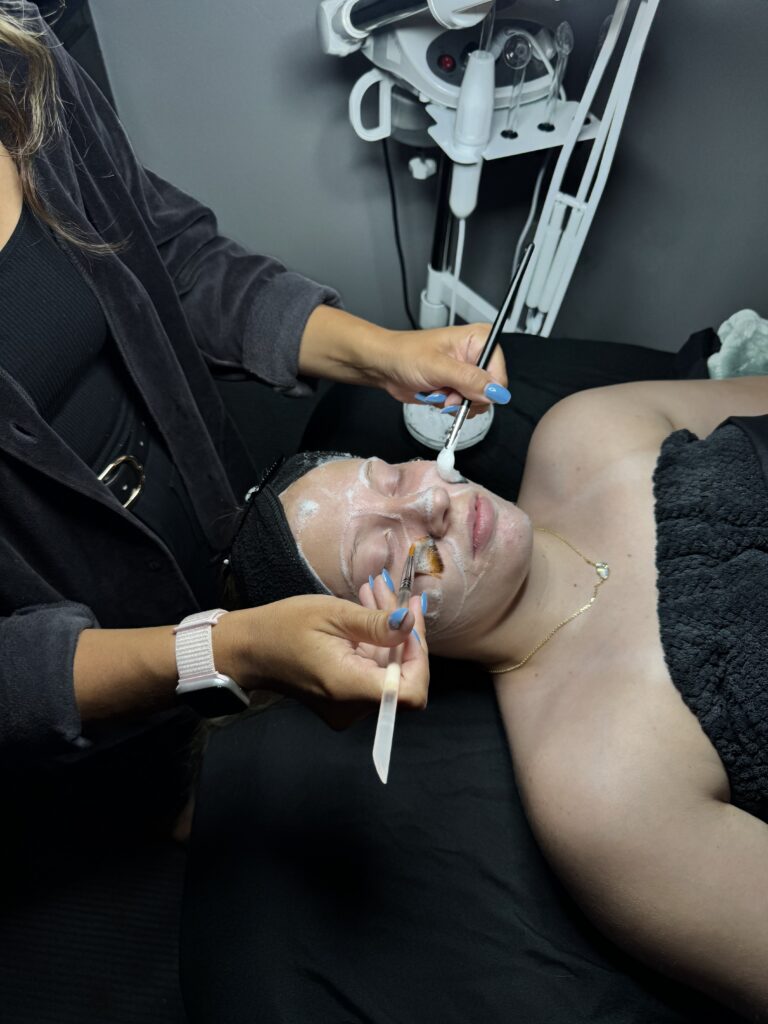
When skin feels rough, dull, or congested, exfoliation is often one of the first things people think about.
Sometimes exfoliation can be useful.
But more is not automatically better.
Scrubs, exfoliating acids, retinoids, and other active products can overlap more easily than people realize. Adding another exfoliating step to an already active routine may leave skin feeling dry, irritated, or more sensitive instead of smoother.
Before reaching for something stronger, look at what you are already using.
Does your cleanser contain an exfoliating ingredient? Are you using a retinol or retinoid? Do you already use an acid serum, toner, peel, scrub, or exfoliating mask?
The question may not be, “What else should I add?”
It may be, “Am I already doing enough?”
And if your skin is actively sunburned, irritated, or uncomfortable, stronger exfoliation is not the place to start.
Your skin barrier matters too
“Skin barrier” has become a popular phrase, but the concept itself is fairly simple.
The outermost layer of your skin helps hold moisture in while protecting the skin beneath it from the outside environment.
When your skin feels comfortable and balanced, you may barely think about it.
When it does not, you might notice tightness, dryness, flaking, sensitivity, or that products you usually tolerate suddenly feel less comfortable.
That does not necessarily mean you need a complete “barrier repair” routine or a shelf full of new products.
Often, simplifying the routine can make it easier to understand what your skin responds well to.
A gentle cleanser, appropriate moisturizer, consistent sun protection, and thoughtful use of active ingredients can provide a much clearer foundation than changing several products at once.
Consistency is not as exciting as a complete skin care overhaul—but it is often much easier to evaluate.
Your skin may need something different than it did in June
Skin care does not have to stay exactly the same all year.
Your environment and routine change.
During summer, you may spend more time swimming, exercising outdoors, traveling, reapplying sunscreen, sitting in air conditioning, or cleansing your face more frequently.
As those habits change, the products and textures that feel best may change too.
That does not mean replacing your entire routine every season.
It may mean something much smaller.
Perhaps your skin needs more consistent moisture.
Perhaps your cleanser needs to feel gentler.
Perhaps you have been exfoliating more often than you realized.
Perhaps the moisturizer that felt too rich in June begins to feel more comfortable as the season changes.
Or perhaps your routine is working perfectly well and does not need to change at all.
The goal is not to create a seasonal shopping list. It is to notice what your skin is telling you before automatically adding something new.
When a professional facial may be helpful
Sometimes it is difficult to tell whether your skin would benefit from more hydration, different exfoliation, a simplified routine, or simply more consistency.
That is where professional guidance can be useful.
A skin care professional can take a closer look at what you are noticing, discuss the products you currently use, and help determine what type of cosmetic treatment may make sense for your goals.
At Savoye, skincare services are approached with the individual guest in mind rather than expecting everyone to need the same facial.
Savoye currently offers Ultraceuticals facial treatments with options ranging from a refining and hydrating facial experience to treatments that incorporate more active exfoliation.
You do not need to arrive knowing which treatment name is right for you.
Start with what you are experiencing and what you would like to improve. From there, your esthetician can help guide the conversation around an appropriate option.
A professional facial can also provide something that is difficult to recreate by simply buying another product: a chance to pause, look at your routine as a whole, and make more intentional decisions about what comes next.
Can skin be oily and still feel dry or tight?
Yes. How shiny the surface of your skin looks does not necessarily tell you how comfortable or moisturized it feels.
If your skin looks oily but also feels tight, rough, or easily irritated, avoid assuming the solution is simply to cleanse more aggressively.
Look at your cleansing routine, moisturizer, exfoliating products, and how often you have been washing your skin.
Should I exfoliate more if my skin feels rough after summer?
Not automatically.
Exfoliation can help remove cells from the surface of the skin, but the right method and frequency depend on your skin and the other products you already use.
If your routine already contains exfoliating acids, retinol, scrubs, or other active ingredients, adding more can increase the chance of irritation.
And exfoliation should be avoided on sunburned or otherwise significantly irritated skin.
Can swimming affect how my skin feels?
It can.
Pool water, time in the sun, repeated rinsing or showering, and spending extended periods in air conditioning can all contribute to skin feeling drier or less comfortable.
Rinsing after swimming and following with an appropriate moisturizer can help support comfortable skin.
What if my skin is sunburned or very irritated?
A sunburn is not the time for aggressive exfoliation or a stronger cosmetic treatment.
Keep the routine gentle while your skin recovers.
If you are dealing with significant pain, blistering, persistent irritation, a changing skin lesion, or another concern that goes beyond normal cosmetic skin care, contact a medical professional or dermatologist.
Ready to understand what your skin may need next?
By the end of summer, your skin does not necessarily need more.
It may simply need a little more attention to what has changed.
At Savoye, the goal is not to put every guest through the same routine. It is to begin with what you are noticing and help guide you toward an approach that makes sense for your skin and your goals.
Want to schedule your visit?